
 561-338-0420
Why Must I Carry Motorcycle Insurance in Oregon?
In accordance with Oregon Revised Statute (ORS) 806.010, Oregon requires that all drivers maintain insurance on their vehicles prior to operating such vehicles on public highways. All motorcycles, mopeds, and autocycles fall under this statute.
One important note: Oregon considers motorcycles to generally include qualifying two or three wheeled self-propelled vehicles that are not classified as mopeds. A motorcycle permit or endorsement is generally required if the bike can travel over 30 mph on level ground or has a combustion engine larger than 50cc.
Motorcycle insurance serves two purposes:
Firstly, the purpose of requiring motorcycle insurance is to prevent others from being burdened with the cost of medical treatment associated with an accident in which you are at fault. Secondly, it prevents you from losing your life savings, income, and other valuable assets should you become liable for damages exceeding the amounts available from your liability insurance carrier(s).
Related Article(s)
Oregon Motorcycle Laws: From Licensing to the “Dead-Red” Rule
Let's Settle For More...

 Click to Call
Minimum Motorcycle Insurance Coverage Requirements in Oregon
Oregon law establishes the minimum levels of coverage that must be included in your motorcycle insurance policy. Below is information regarding each type of coverage and the amounts established by Oregon law:
| Coverage type | Legal minimum | What it covers |
|---|---|---|
| Bodily injury liability | $25,000 / person $50,000 / crash |
Pays for injuries you cause to other people in an accident. |
| Property damage liability | $20,000 / crash | Pays for damage you cause to other people’s property. |
| Personal injury protection (PIP) | Not Required
Highly Recommended |
Covers your medical expenses regardless of who caused the crash. |
| Uninsured / underinsured motorist (UM/UIM) | $25,000 / person $50,000 / crash |
Pays for your injuries if the at-fault driver has no insurance or not enough. |
You may refer to ORS 806.010 to view the statute that outlines Oregon’s financial responsibility law.
Keep in mind that although these are the minimum amounts of coverage required by Oregon law, they do not represent the maximum amount of coverage possible. Unfortunately, medical bills resulting from a serious motorcycle crash can quickly exceed the limits of your liability insurance coverage. Oregon policies may include PIP benefits, but motorcycle policies can be different. Review your policy or ask your insurer how PIP applies to your motorcycle crash.
Why PIP and UM/UIM Coverage May Matter After a Motorcycle Crash
Since Oregon is considered an at-fault jurisdiction, it follows that the driver who causes an accident is liable for paying all resulting damages. Therefore, why would Oregon also mandate underinsured/uninsured motorist coverage?
Because many motorists do not purchase sufficient insurance coverage (if any) to compensate those injured in car wrecks caused by them, Oregon mandates uninsured motorist coverage on motorcycle policies so that if you are hit by an uninsured motorist and cannot obtain compensation from him/her, you can seek reimbursement through your own policy.
Personal Injury Protection (PIP) is also highly recommended; because determining liability for a car crash can take considerable time, even months or longer, personal injury protection allows injured parties immediate access to funds for treating their injuries and replacing lost income while waiting for an insurer to determine liability for payment.
It’s also very important to note that timing plays a critical role in filing personal injury protection and uninsured motorist claims. Virtually all policies specify timeframes during which such claims must be filed, and failure to do so in a timely manner may limit your ability to recover on your claim.
Motorcycle Accident Lawyer
Get Your FREE & Confidential Case Review Today.Optional Types of Motorcycle Insurance Coverage
While meeting the statutorily required minimum levels of coverage will allow you to drive legally, it may not provide you with maximum protection. Depending upon various factors (such as the cost of repairing or replacing your motorcycle, the extent of your riding experience, and your financial resources), there may be other types of motorcycle insurance coverage that you will want to consider adding to your existing coverage. Some examples of these optional forms of motorcycle insurance coverage include:
Collision coverage insures damage to your motorcycle caused by an accident; regardless of whether you were at fault. As such, if your bank loaned you money to buy your motorcycle, it likely will require you to carry this type of coverage.
Comprehensive coverage covers any damage to your motorcycle caused by anything except a collision, including theft, vandalism, fire, falling objects, and inclement weather conditions. If you’ve spent any money modifying your motorcycle (e.g., installing high-performance exhaust systems; repainting or powder-coating its bodywork; upgrading its lights, etc.), comprehensive coverage is something you’ll definitely want to consider purchasing.
Medical payments (MedPay) provide supplemental medical expense benefits that help pay for some medical-related expenses that exceed the limits provided under your PIP portion of your policy. Since med pay typically costs very little more than the premium charged for basic liability coverage alone, it is a highly recommended option.
Custom part/accessory coverage helps protect your investment in any aftermarket components that are installed on your motorcycle. Although most standard motorcycle policies will only insure the fair market value of the original manufacturer-installed equipment on your motorcycle, not the enhanced value added by any aftermarket accessories, this specialized coverage can help protect the value of any customizations you made to enhance your motorcycle.
Trip interruption/roadside assistance coverage provides emergency roadside service and towing services, in addition to possibly covering overnight accommodations or transportation expenses incurred if you break down away from home. While not exciting, this form of coverage can be helpful.
Umbrella policies increase your total liability limits above and beyond what is provided under your primary motorcycle policy. Therefore, if you have significant net worth assets that you would prefer to protect in the event of a serious crash involving significant damages awarded to third-party claimants, this may be worth discussing further with your insurance representative.
When making decisions concerning how much coverage you wish to purchase, ask yourself how much money you could lose if you were found liable for serious injuries suffered by third parties in a motorcycle wreck. While meeting the minimum statutory coverage levels will enable compliance with Oregon’s motorcycle insurance requirements, they do not necessarily equate with obtaining full financial protection against potential loss in the event of an accident.
Regulations Concerning Equipment & Safety Standards for Street-Legal Motorcycles in Oregon
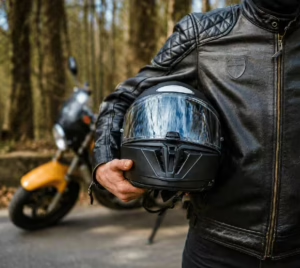 In addition to complying with Oregon’s insurance regulations regarding motorcycles, street-legal motorcycles in Oregon must also meet specific safety and equipment standards established by the state prior to being allowed on public roads. Below are some key requirements for street-legal motorcycles:
- DOT-approved helmet for all riders and passengers
- White headlight that must remain on while riding
- A rear red taillight and brake light
- A rear red reflector
- Turn signals (only applicable to motorcycles manufactured after January 1, 1972)
- A mirror on at least one side
- A horn audible from at least 200 feet away
- Front and rear fender assemblies
- A functioning exhaust system and muffler meeting Oregon’s decibel standards
Oregon prohibits Lane-splitting and weaving between vehicles; both are considered moving traffic infractions in Oregon.
Newer riders may benefit from completing Oregon motorcycle safety program courses. Successful completion can lower your likelihood of experiencing a crash and may also entitle you to receive an insurance rate reduction.
Let's Settle For More...
Penalties for Riding a Motorcycle Without Insurance or With Improper Equipment
Under ORS 806.010, riding a Motorcycle without insurance in Oregon is a class B traffic violation. In addition to potential fines, depending on the situation, there is also potential for the towing of your motorcycle, suspension of your driver’s license, and the requirement to provide proof of insurance for one full year after the violation. You expose yourself to tremendous financial risk. If you are involved in an automobile accident and are at fault while uninsured, you are personally responsible for paying for all the damages caused by the accident, including the other parties’ injuries and/or damaged property. The potential cost of this responsibility can be in the tens of thousands of dollars, depending on the severity of the wreck, and include the cost of hiring an attorney to defend you in a civil trial.
In addition to the above mentioned potential penalties for riding a motorcycle without insurance, if you are involved in a motorcycle accident and are found to have had improper or inadequate equipment on your motorcycle (i.e., broken taillights, non-functioning turn signals, etc.), you may receive a “fix-it” ticket at a minimum. Additionally, if you are sued by another party due to an accident involving your motorcycle, it may be used to establish that you were contributorily negligent (you were partially at fault) because your equipment was defective or incomplete.
Oregon’s At-Fault System and Options for Compensation After an Accident
After a motorcycle accident occurs in Oregon, the person(s) deemed responsible for causing the accident (“at-fault”) are responsible for paying the costs associated with the damages. While this system appears simple in theory, many variables can arise during the claims process, which complicate things further. Most notably, many times when the damages sustained from an accident are substantial and/or insurance companies are involved, obtaining compensation can be difficult.
As an injured motorcycle rider, you generally have three main ways to pursue compensation:
First option: you can submit a claim to your own insurance provider. Specifically, you would submit a claim for personal injury protection (PIP) benefits to cover your immediate medical expenses and underinsured/uninsured motorist coverage (UM/UIM) benefits if the at-fault driver is uninsured or has insufficient insurance coverage.
Second option: you can submit a Third-party claim to the at-fault driver’s insurance carrier. Generally, this method provides the best opportunity to recover compensation for your non-medical damages such as pain and suffering, lost income, etc. Since pip does not cover these types of losses.
Third option: if a reasonable settlement cannot be reached through the insurance process, you can bring a lawsuit against the at-fault driver in civil court.
Even though you are entitled to coverage under your own insurance policy, insurance carriers are not advocates for you. Insurance adjusters work solely for the benefit of their employer (the insurance company). Their job is to limit what they pay in claims. Immediately following an accident, they begin compiling information regarding your claim. Hiring an attorney helps ensure that someone else is fighting on your behalf. The attorney will assist in collecting evidence at the scene of the accident, obtain expert opinions from physicians or engineers, document and preserve all available evidence related to your claim, and make certain that your total damages are properly documented prior to accepting any type of settlement agreement offered by the insurance company.
If you have been seriously injured in a Motorcycle Accident, we would strongly encourage contacting ELG Injury Lawyers before discussing your claim with any insurance company. Our consultation is complimentary, and our attorneys only charge clients for representation if they recover money on their behalf.
Choosing the Best Motorcycle Insurance Policy
Finding good Motorcycle insurance policies can be easy; however, it is important to put some thought into selecting a good policy. The following represents an efficient method of shopping for Motorcycle insurance policies:
Identify your risk profile. Do you ride every day? Do you ride primarily in urban areas or rural areas? Are you an experienced rider or an inexperienced rider? Commuting each day through heavy traffic in an area like Portland poses vastly greater risks than occasional weekend riding in less populated rural areas.
Determine the types of coverage you need. There is usually very little difference between the types of coverage mandated by the state and what most people want to purchase. As a general rule, if your Motorcycle is worth more than $10-$15k, then purchasing collision coverage makes sense. Comprehensive coverage protects you from damage due to theft or vandalism. Medical payments coverage protects you should you suffer an injury, regardless of whose fault the Accident was. Liability limits refer to how much money is provided should you cause an Accident that results in bodily injury or property damage to others.
Get multiple quotes. There are significant differences in pricing among insurance carriers. Your premium will depend on several criteria, including: your age; your driving history; your credit score; the type of Motorcycle you drive; and where you reside.
Read the fine print before signing any agreement. Carefully examine what is excluded from your policy. Also, understand what your deductibles and limits are. Some cheap policies come with large deductibles or exclusions that render them ineffective once a problem arises.
Ask about discounts. Many carriers offer discounts for completing a Motorcycle safety course, purchasing Motorcycle insurance along with auto insurance, membership in a riders organization, or having a clean driving record.
Ultimately, your objective is to find a policy that adequately insures you while allowing you sufficient room within your budget to afford it. While saving a few bucks per month by cutting back on coverage may seem appealing now, it can ultimately end up costing you significantly more if an Accident occurs and leaves you financially exposed.
Let's Settle For More...
Cost of Motorcycle Insurance Policies in Oregon
Motorcycle insurance in Oregon tends to be reasonably priced, especially if you only maintain the mandatory minimum levels of coverage. According to Progressive, in 2024, liability-only motorcycle insurance policies in Oregon averaged approximately $199 annually ($16.67 monthly).
Your actual annual premium price will rely on numerous factors, including your age, your location, the manufacturer/model of your motorcycle, your Riding background/history, and the amount of coverage you opt to purchase. Younger riders and riders who have previously violated traffic laws pay more. Riders who commute regularly through densely populated cities like Portland will typically pay more than riders who travel extensively through less populated areas outside of city centers.
You should give careful consideration to determining whether maintaining only the minimum amount of coverage (which will save you money now) will ultimately leave you vulnerable to out-of-pocket expenses if: (a) you are involved in a serious crash with another vehicle that lacks adequate insurance coverage, and (b) your motorcycle is severely damaged and requires replacement, with no collision coverage.
Commonly Asked Questions
Do I have to get insurance for my moped or scooter in Oregon?
In Oregon, mopeds and scooters are considered different types of vehicles. For example, a moped is generally defined by its inability to exceed 30 mph on flat land, and if it is gas-powered, the engine size (displacement) will typically range from 35.01-50 cc. In addition to having a valid driver’s license, a moped operator does not need a motorcycle endorsement. However, all mopeds are required to be registered with the state and must be insured prior to operation upon a public roadway or a property that is open to the general public.
Is lane splitting legal in Oregon?
No. Lane splitting (Riding between two lanes of moving traffic) and weaving between two lanes of traffic are both prohibited under Oregon statute. Both actions can lead to citations and may be argued as contributing negligence (you were partly at fault) if involved in an Accident.
Are there age limitations for motorcycle passengers?
There is no age limitation for motorcycle passengers in Oregon; however, if you intend to transport a passenger on your motorcycle, it must first be equipped with a designated passenger seat and footrests. A passenger riding without appropriate seating/equipment constitutes a violation.
What happens if I am hit by another driver who is not insured?
This is precisely why your uninsured motorist coverage exists. Submit a claim with your own carrier for um coverage to compensate you for any injuries suffered. If your damages exceed your UM coverage limits, consult with an attorney representing injured victims of accidents caused by uninsured motorists.
How do I prove my motorcycle is insured?
Proof of insurance can be either hard copy or digital (e.g., stored electronically on your smartphone) and must always be produced upon demand by law enforcement officials. Failure to present proof of insurance may result in a citation despite possessing valid insurance coverage.
Protect Yourself & Be Aware of Your Rights!
Oregon law mandates that motorcycles have minimum amounts of liability insurance for good reason. These provisions mandate that all motorcyclists have some form of financial protection for themselves and others on the roadway. However, liability insurance only provides limited financial protection. In the event that serious harm is incurred in an accident and your policy limits are exceeded by the extent of your damages, then you will be left with potentially catastrophic financial exposure.
To maximize your protection on the highway, use protective gear when operating your motorcycle, keep your bike street-ready, and buy enough insurance coverage so that if an accident occurs, you’ll be sufficiently protected financially. When involved in an accident and dealing with your insurance carrier or filing suit against another driver or his/her carrier, never attempt to handle matters independently.
At ELG Injury Lawyers, we provide representation services for injured motorcyclists throughout Portland and across the entire state of Oregon. We recognize how the insurance industry functions, and we know how to advocate aggressively on behalf of injured victims to collect everything they rightfully deserve for their claim.
Last updated Friday, September 4th, 2026