
 561-338-0420
Motorcycle Licensing and Endorsement
Unless you have a motorcycle endorsement on your driver’s license, you cannot legally ride a motorcycle on public roads in Oregon. Oregon does not offer a stand-alone motorcycle license. Instead, the motorcycle endorsement is attached to your existing Class C license. There are two ways to obtain the motorcycle endorsement.
Path one: Complete the Basic Rider Training or Intermediate Course with an online classroom offered by Team Oregon to satisfy the skills test requirement. In order to qualify to take the skills test, you need a typical Class C license/instruction permit. As Oregon’s designated motorcycle safety organization, recommended by Oregon DMV, Team Oregon offers a basic course that is designed to teach new riders basic riding skills in a safe environment. You can get your motorcycle instruction permit through the DMV prior, but it is not required to take the skills test. If you choose this online course option through Team Oregon with just a Class C driver’s license, you will still have to take the motorcycle endorsement knowledge test through the DMV to receive your endorsement.
Path two: You can take the Basic Rider Training course with an in-person classroom offered by Team Oregon. Upon successful completion of the in-person courses, you will be eligible for a motorcycle endorsement and will not be required to take the knowledge test administered by the Oregon DMV. You do still have to go to the DMV to complete the process, such as satisfying fees and typical residency proof.
Instruction Permits
While you are pursuing your motorcycle endorsement but still have not completed the process, you can apply for a motorcycle instruction permit. Motorcycle instruction permits come with restrictions, including rules about passengers, riding hours, and supervision. Before riding, confirm the current permit restrictions with the Oregon DMV. Please do not consider the permit as a means of avoiding supervision, as new riders are much more likely to be involved in crashes due to a lack of experience.
To find out more about current fees, testing locations, and the official knowledge test study materials available, please visit the Oregon DMV website located at oregon.gov/odot/dmv. For more information on Team Oregon and its offerings, please visit https://team-oregon.org/
Related Article(s)
Oregon Motorcycle Insurance Requirements: A Complete Legal Guide
Let's Settle For More...

 Click to Call
Helmets and Safety Gear Requirements
Oregon has enacted a universal helmet law. Under ORS 814.269, each motorcycle operator and each motorcycle passenger must use a helmet that complies with U.S. Department of Transportation (DOT) standards. Regardless of whether the trip is long or short, whether or not you are an experienced rider, or if you are simply moving the vehicle into position on the driveway, the helmet law applies.
How is a DOT-approved helmet identified? Each approved helmet must display a DOT label on the back indicating compliance with federal regulations governing the safety features of impact protection, penetration resistance, and retention. Novelty helmets and lightweight “brain buckets” that appear as helmets but provide little-to-no actual protection do not comply with DOT standards regardless of any labels appearing on such items. If you are unsure as to whether or not your helmet is DOT compliant, purchase your helmet from a reputable retailer and request confirmation of DOT compliance.
A violation of this regulation results in fines. More importantly, however, failing to properly secure yourself in an accident scenario will almost always be raised as an issue in any subsequent claims for damages. Pursuant to Oregon’s comparative negligence statutes, your failure to use reasonable safety measures (e.g., wearing a properly secured helmet) will significantly reduce your recovery amount.
Motorcycle Accident Lawyer
Get Your FREE & Confidential Case Review Today.Other Safety Measures Beyond Helmets
Oregon law requires no additional protective gear beyond helmets for operators aged 21 years or older. However, if you’ve ever witnessed road rash after a crash at speeds reaching 45 miles per hour, you’ll understand why so many injured riders arrive at our office wearing shorts and shirts. Protective gear worth considering:
- Leather or reinforced textile jackets with CE-rated shoulder and elbow armor
- Gloves specifically designed for motorcycle riding
- Ankle-high boots providing support for ankles
- Pants providing knee and hip armor
Again, we aren’t trying to lecture anyone. These are examples of what we commonly see in our practice and examples of things that make a difference for both your physical well-being and your ability to collect fair compensation for injuries sustained while operating a motorcycle.
Street Legal Motorcycle Equipment Requirements
Oregon law stipulates what equipment must be present on street-legal motorcycles and mopeds in order to be permitted on public roads. Prior to taking your motorcycle on public roads for the first time, ensure that your motorcycle is fully equipped with all of the following:
- Headlamp capable of producing sufficient illumination (must be operational day and night)
- Taillamp(s) and brake lamp(s)
- Minimum of one mirror
- Turn signals (operational on newer models, exempted on older models)
- Horn audible at a minimum distance of 200 feet
- Muffler or exhaust system meeting Oregon’s noise specifications
- Front fender(s) and rear fender(s)
- Operational brakes on both front and rear wheels
Motorcycle Modifications, Aftermarket Parts & Accessories
The State of Oregon prohibits exhaust systems or accessories designed to increase engine decibel levels beyond those permissible in Oregon.
Oregon Law Enforcement officials consider the “loud pipes save lives” rationale to be irrelevant when assessing violations of Oregon Law regarding excessive noise generated by a motorcycle exhaust system. Therefore, you may be issued a citation for modifying your motorcycle exhaust system to generate excessive noise.
Decorative lighting, such as underglow lighting, is permissible in certain configurations; however, Oregon Statutes prohibit red coloration (red is reserved for Emergency Vehicles) and blue coloration. Be mindful of the positioning and coloration of your motorcycle lighting to ensure compliance with the Oregon Vehicle Code.
Electric Motorcycles
There are no differences in equipment and licensing requirements for electric motorcycles compared to gas-powered motorcycles in Oregon. An Electric Motorcycle must comply with the same standards for lighting, rearview mirrors, brakes, and other required equipment as a Gas-Powered Motorcycle.
However, Oregon offers several rebates and incentives for electric vehicles (including motorcycles), such as the Oregon Clean Vehicle Rebate Program. Therefore, if you are planning to purchase an electric motorcycle, it would be wise to investigate these options.
Conversion of Off-Road Bikes for On-Road Use
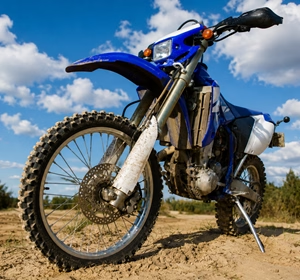 It is generally difficult to convert an off-road bike into a road-capable bike. While the Oregon DMV provides a method for converting off-road bikes to Road-Capable bikes, not all Off-Road Bikes are eligible. A converted off-road bike must undergo inspection to determine compliance with all applicable road equipment requirements. It is recommended to contact the DMV prior to commencing any attempt to convert an off-road bike to avoid unnecessary costs and delays.
Mopeds
In Oregon, mopeds are regulated by different means than motorcycles. In general, a moped with a gasoline engine will be considered a moped if it does not have a manual transmission (i.e., an “automatic power drive”) that allows the vehicle to travel faster than thirty mph on flat land, and/or has an engine displacement of less than 50cc. If either of these two conditions cannot be met, then the vehicle may be classified as a motorcycle instead of a moped.
A valid driver’s license issued from any class may be used to ride a moped in Oregon, and no motorcycle endorsement is needed. All mopeds must be registered, and when ridden on public roads or areas open to the public, the moped operator must carry moped/motorcycle liability insurance. In the event that you are injured in a collision involving your moped, the same principles that apply to determining responsibility for injuries or property damage under Oregon law, including whether the other party had liability insurance coverage and how much responsibility each party bears due to their own negligent actions, may apply.
Let's Settle For More...
Road Rules: Lane Use, Lane Sharing, and Lane Splitting
Two subjects that frequently receive inquiries from motorcycle riders in Oregon are lane splitting and lane filtering. Neither activity is permitted in Oregon.
Lane splitting involves passing between lanes of stationary or moving traffic. Although many riders may see motorcyclists weaving through traffic lanes, this activity is prohibited in Oregon.
Lane filtering refers to passing between stopped vehicles at a stoplight or stop sign to move to the front of the line of stopped traffic. Several states have recently enacted legislation permitting lane filtering, but Oregon has not passed such legislation. Although there has been consideration given to this type of legislation in Oregon, House Bill 2314 (similar to Utah and Montana laws) was introduced during one legislative session to enact this provision. As of the writing of this book, HB 2314 had not been signed into law. It is possible that future legislation will address this area of concern. Please visit the Oregon Legislative Assembly website (oregonlegislature.gov) for information related to the status of any proposed legislation related to motorcycle operation.
As a comparative reference point, California was the first State to permit lane splitting in 2016. Currently, California remains the only State in the country where lane splitting has been formally approved by statute. If you have previously ridden in California and now reside in Oregon, this distinction should be important to you.
Lane Sharing
On the other hand, two motorcycles are permitted to share a single lane in Oregon. This type of riding is referred to as “lane sharing.” Although Oregon permits lane sharing, it should be noted that lane sharing is not always advisable. At high speeds, maintaining a safe distance between yourself and the motorcycle riding alongside you becomes increasingly difficult.
For example, if you encounter an unexpected hazard or obstacle while traveling at highway speeds with another motorcycle in adjacent proximity to your motorcycle, it may be difficult to react quickly enough to maintain control of your motorcycle and prevent injury to yourself or others. Many experienced motorcycle riders selectively choose when to engage in lane sharing based upon the circumstances present at the time.
Group Riding
When participating in group riding activities, many experienced riders prefer to employ a “staggered formation”. Staggering your formation allows each individual member of the group sufficient space to follow safely behind each other while enabling each rider to observe the path ahead. Staggering your formation also enables each rider to establish their own speed independently.
Passenger Laws in Oregon
Oregon has a number of requirements that you will need to meet in order to take another person on your motorcycle. First, there has to be a dedicated passenger seat on your motorcycle. You cannot carry a person on a cargo carrier or on a tank bag. Second, your motorcycle must have passenger footpegs. Third, both the operator and the passenger must be wearing a Department of Transportation (DOT)-certified helmet. Fourth, the passenger must be physically able to operate the footpegs and hold onto something.
Minimum Age
There is no statutorily defined minimum age for motorcycle passengers in Oregon. This may seem surprising, but Oregon leaves it to the adult operating the motorcycle to decide if he believes his child can safely ride as a passenger. Practically speaking, however, a child will not be physically able to reach the footpegs and secure themselves on a typical motorcycle.
Riding with Children
When planning to transport Children as passengers on your motorcycle, consider these factors: first, the child should wear a properly fitting DOT-certified helmet. Typically, this means purchasing a helmet designed specifically for Children. Second, the child must be physically large enough to grasp your body and reach the footpegs. Lastly, consider the child’s focus and ability to remain still during the length of time you intend to ride. A restless or shifting child will negatively impact the balance of your motorcycle.
Resources: The Motorcycle Safety Foundation (MSF) provides information on safe transportation of passengers, including Children. Team Oregon also offers resources related to transporting Children as passengers.
Liability Insurance Obligations and Optional Coverages
In Oregon, every motorcycle operator is mandated to carry at least the following levels of liability insurance:
| Coverage type | Minimum required |
|---|---|
| Bodily injury per person | $25,000 |
| Bodily injury per accident | $50,000 |
| Property damage per accident | $20,000 |
Note: these are the mandatory minimums. We would like to clearly indicate that these amounts are far from sufficient. Serious motorcycle accidents can quickly result in medical costs exceeding $25,000. The cost of an overnight hospitalization in an intensive care unit (ICU), along with surgical costs and subsequent physical therapy costs, can rapidly escalate to several hundred thousand dollars. If the other party involved in a crash is insured only to the minimum level and you suffer serious injuries, you could face tens of thousands of dollars in medical expenses not covered by their limited insurance.
Uninsured/Underinsured Motorist Coverage (UM/UIM)
Typically, Oregon automobile insurance policies will require Uninsured Motorists (UM) coverage. The UM coverage will also provide Underinsured Motorists (UIM) coverage for physical harm or loss of life. UM/UIM coverage limits should normally be equal to your Bodily Injury Liability Limits unless you request less than that limit in writing. Oregon Law prohibits UIM/UM limits from being below the State Minimum Required Bodily Injury Coverage.
The purpose of UM/UIM is to give you protection when the person at fault either has No Insurance or does not have sufficient insurance to pay for all damages resulting from a crash. Due to the fact that severe crash-related injuries can quickly exceed minimum policy limits it is possible that having ample UM/UIM coverage could greatly impact how much you receive as compensation after an accident.
Oregon UM/UIM coverage depends on your policy terms and Oregon law, including ORS 742.502. Check your declarations page to confirm your actual uninsured and underinsured motorist limits. Legal matters can become confusing quickly, so remember that you can call us anytime with questions. We’re here to help you with all the legal aspects of your case. No question is too small.
Personal Injury Protection (PIP)
PIP is typically required by law on all automobile insurance policies for private passenger vehicles in Oregon. Regardless of who is at fault, if you were involved in an accident PIP will pay for your reasonable and necessary medical bills, as well as some lost wages.
The minimum amount of medical coverage that Oregon requires through PIP is $15,000.00 per person. This coverage applies to qualifying medical bills incurred due to injuries sustained from the time of the accident until two (2) years after the date of the injury.
Unfortunately, Oregon doesn’t require personal injury protection (PIP) on a motorcycle insurance policy. As a motorcycle owner, you need to thoroughly check your policy documents to see if you purchased PIP or any additional optional medical coverage, and to identify what benefits would be available if you’re injured while riding your motorcycle.
More Optional Coverage Worth Considering
| Coverage | What It Does |
| Collision | Covers repair or replacement of your motorcycle after an accident |
| Comprehensive | Covers theft, vandalism, and non-collision damage |
| Medical payments | Supplements health insurance for accident-related medical bills |
| Gap coverage | Covers the difference between what you owe and what the bike is worth if it’s totaled |
Our advice: buy more coverage than the minimum if you can afford it. Insurance feels like dead money until you need it.
We believe that, if possible, you should purchase additional coverage beyond the minimum requirements for your own peace of mind and potential future financial security.
Let's Settle For More...
Oregon’s Red-Light Law (“Dead-Red” Rule)
Many motorcyclists in Oregon are well aware of this law. What many motorcyclists do not know about this law is its application or requirements. Understanding this law can greatly benefit motorcyclists.
The Problem It Solves
The vast majority of intersections throughout Oregon are equipped with vehicle actuation systems, utilizing loops placed in the roadways near the curb lines to measure traffic flow. Vehicles with enough “mass,” such as cars, trucks, etc., create a magnetic field when passing over the loops, thereby triggering the light to turn green for traffic entering that intersecting street. Unfortunately for motorcyclists, many motorcycles weigh less than 400 pounds and lack sufficient mass to activate these loops and subsequently receive a green light. As a result, motorcyclists often find themselves stuck at red lights long after cross traffic has received a green light.
Prior to the enactment of SB 533 and subsequent amendments to the applicable sections of the Oregon Revised Statutes, motorcyclists had three choices: 1) wait until someone pulled up behind them or until they saw cross traffic receive green lights. 2) Make an illegal movement through the intersection. 3) continue to sit at the red light until they run out of patience.
What the Law States
SB 533 created Oregon’s version of the “dead-red” rule allowing motorcyclists to proceed through red lights under certain circumstances. Specifically:
- The traffic control device is vehicle-actuated (i.e., controlled by loops).
- The signal fails to change to green after one full cycle.
- The operator stops completely prior to attempting to pass through the intersection.
- The operator yields to any traffic or pedestrians crossing through or approaching the intersection.
In summary: stop completely at the red light; wait at least one full cycle; yield to all traffic or pedestrians that have the right-of-way; proceed with caution.
Step-by-Step: Using the Dead-Red Rule to Pass Through an Intersection
- Position yourself over the loop sensor at the intersection, usually denoted by a rectangle or diamond shape in the asphalt.
2. Come to a complete stop.
3. Wait for at least one complete signal cycle: watch cross-traffic get a green light, go through their cycle, and come back around to red.
4. Before proceeding through the intersection, check for any traffic or pedestrians that may have a green light or right-of-way and yield accordingly.
5. Proceed slowly and cautiously through the intersection.
What Happens If You Are Stopped By the Police?
While rare, it is possible that police officers unfamiliar with the “dead-red” rule may issue citations for running red lights. Remain calm, courteous, and politely inform them you were invoking your rights under the “dead-red” rule. Reference Senate Bill 533 and/or cite the amended statute in Oregon Revised Statutes. Consider printing this document and carrying it with you on rides.
If you are issued a citation despite invoking your rights, you may choose to fight it. Consult with an attorney experienced in motorcycle law regarding whether you meet all of the requirements specified under Oregon law.
Scenario Example
Imagine yourself traveling home from work on a Tuesday afternoon. You arrive at an intersection where you have traveled numerous times previously. As cross-traffic receives a green light and moves forward, you realize that your red light has remained red. After waiting for cross-traffic to clear and then again waiting for the second round of green lights for cross-traffic, your red light has still remained red. You now qualify as meeting one full cycle of failure for vehicle detection of your motorcycle at this intersection. Look left and right for any vehicles or pedestrians that have entered the intersection and see that neither has the right-of-way. Slowly and carefully drive through the intersection.
This example demonstrates how the law functions appropriately.
Comparison Between Oregon State & Other States
Idaho enacted a similar permissive inference law governing motorcycles; Washington state followed suit with an analogous law as well. Multiple states, including Arizona, Arkansas, Minnesota, and Virginia, have passed their own variations of this legislation. Each state varies slightly in terms of requirements, so when riding across state borders, research each state’s specific regulations.
Important Note
Please keep in mind that Oregon’s “Dead-Red” Rule is narrowly defined and is not carte blanche permission to run red lights whenever you feel impatient or uncomfortable waiting. If you run a red light using this provision when there is nothing wrong with the operation of the traffic signal equipment itself and you simply did not wish to wait longer than five seconds to continue driving past a red light, you will have committed an offense worthy of significant civil liability if you cause an accident while doing so. Oregon motorcycle rules should not be mixed together with bicycle, moped, scooter, or e-bike rules. Your rights and responsibilities depend on the type of vehicle involved, including signal rules, lane position, equipment requirements, and insurance obligations.
Let's Settle For More...
Other Important Laws and Considerations for Motorcycling in Oregon
Electric and Alternative Motorcycles
Electric motorcycles, such as the Zero SR/F and the Harley-Davidson LiveWire, are treated exactly like gas-powered motorcycles in Oregon. Electric motorcycles must receive a motorcycle endorsement, must comply with all equipment standards required of gas-powered motorcycles, and must follow all traffic laws applicable to gas-powered motorcycles. Oregon offers various financial incentives for electric vehicles, including rebates that could potentially apply to electric motorcycles. Check www.oregon.gov/energy for current incentive programs.
Out-of-State Riders
Regardless of where you come from, Oregon traffic laws apply once you enter the State. This includes Oregon’s helmet requirement, obtaining the proper motorcycle endorsement for your out-of-State license, and following Oregon’s ban on lane splitting. Lane splitting is illegal in Oregon; however, it is permitted in some states. Therefore, if you ride into Oregon from California, for example, assume California’s lane-splitting rules no longer apply to you.
Oregon honors motorcycle endorsements obtained in other states, but if you intend to establish Oregon residency, you will need to obtain an Oregon motorcycle endorsement within 30 days.
Noise and Emissions
As described by ORS Chapter 815, Oregon sets its own Noise standards for motorcycle exhaust. Any motorcycle produced after 1985 must not produce excessive Noise. Additionally, any modifications made to increase exhaust Noise above Oregon’s permissible level are prohibited. While enforcement of Oregon’s noise regulations is irregular, there is still potential for a penalty. Moreover, increased exhaust Noise can negatively impact your ability to successfully complete Oregon DEQ emissions testing in some counties.
Parking in Oregon
In general, in Portland, motorcycles are allowed to park in most metered parking zones for free. However, restrictions vary based upon the zone in question. Free motorcycle parking is available at Portland International Airport. There are two designated motorcycle parking areas located at PDX. Both of these locations are situated in the parking garages on the arrival and departure levels. Regardless of where you park your motorcycle, save your ticket, because the free parking depends on properly utilizing the designated motorcycle parking areas. For citywide parking information, check with the Portland Bureau of Transportation at www.portland.gov/transportation for details about motorcycle parking regulations by district.
Mopeds and Scooters
As previously discussed, mopeds (less than 50 cc engine capacity, maximum 30 mph) and scooters are categorized separately from motorcycles in Oregon. Mopeds/Scooters do not require a motorcycle endorsement but rather a valid Oregon driver’s license. Registration requirements also differ between mopeds/scooters and motorcycles.
Crash Statistics and Safety Tips
Motorcyclists are disproportionately represented among Oregon traffic fatality victims. According to data released annually by the Oregon Department of Transportation (ODOT), motorcyclists represent a disproportionate number of traffic deaths relative to their numbers among registered vehicles on the highway. For example, during one recent reporting period, motorcyclist fatalities accounted for approximately 15-20% of total reported traffic fatalities statewide.
The majority of serious crashes that result in injury or fatality to Oregon motorcyclists occur due to the following factors:
Left turn collisions. Left turns cause more serious crashes involving motorcyclists than almost any other factor. The typical explanation given by the left-turning vehicle operator is that he/she did not see the oncoming motorcyclist.
Distracted driving. Driver distractions, such as using their cell phones, adjusting radios, or eating, can result in the driver failing to observe motorcyclists who are lawfully operating in traffic lanes.
Hazards on roads. Hazards such as gravel on curved sections of highways, wet pavement, raised pavement edges, railroad crossings, potholes, and roadside debris create hazards for motorcyclists that automobile operators rarely recognize. These hazards are multiplied by Oregon’s wet weather months (October through June).
Intersections. Many motorcycle crashes occur at intersections. Intersections create opportunities for motorists to run red lights or make improper right-hand turns, as well as provide less-than-perfect sight lines for motorcyclists.
Safety Tips for Riding a Motorcycle
Always ride as if automobile drivers cannot see you. Sometimes they can’t.
Position yourself in your lane where you will be seen most easily. Typically, this is along the left edge of your lane where drivers checking their mirrors will see you best. Always avoid riding in an automobile driver’s blind spots.
Use high-visibility clothing and accessories to help others see you. Yellow or orange vests, jackets with reflective strips, and brightly colored helmets all improve your chances of being noticed.
Use smooth progressive braking techniques. Almost all motorcycles have greater front-end braking force than rear-end braking force, but locking up the front tire creates far more hazard than locking up the rear tire. Develop your braking technique in a safe location so it becomes second-nature.
Check intersections before entering them, even when you have a green light. Automobiles turning right (or making U-turns) and automobiles running red lights or stop signs ignore your right-of-way as much as pedestrians ignore your rights.
Comparative Fault and Compliance
Because Oregon uses a modified comparative negligence system (see ORS 31.600), your own adherence to traffic laws directly impacts the amount of compensation you receive if you are injured in an accident. Your lack of compliance can greatly reduce the amount of damages awarded to you. If you are deemed 50% or more responsible for the accident resulting in your injury, then you will receive no compensation. Likewise, if you are determined to be 30% responsible for your injury-causing accident, then your compensation will be reduced by 30%.
Therefore, adhering to traffic laws is important for reasons beyond merely avoiding a fine.
Insurance companies and defense attorneys will use anything they can find against you
Not only will insurance companies seek to find fault with you regarding your actions before or during the accident that caused your injuries, but defense attorneys will likely do the same.
Examples of ways insurance companies and defense attorneys can use non-Compliance with traffic laws against you include:
- Not wearing a helmet
- Lane splitting
- Speeding
These examples illustrate why it is so important to always ride safely and within the bounds of Oregon traffic laws.
Let's Settle For More...
Legal Rights and When to Contact an Attorney
Oregon Modified Comparative Negligence Law
Modified comparative negligence (ORS 31.600) is used by Oregon courts to determine fault among parties involved in accidents resulting in personal injury. Under this law, if you contribute any degree of fault to the accident causing your injuries, then your compensation will be reduced by the percentage attributed to you. If you are deemed 51% or more at fault for causing your injuries via an accident involving two parties, then you are not able to recover compensation whatsoever. This demonstrates how your non-compliance with Oregon traffic laws can severely impact your entitlement to damages in court.
Actions to Take Following a Motorcycle Accident
Call 911 immediately. Even if you believe your injuries appear minimal, getting emergency services to the scene is vital. Traumatic brain injury and internal bleeding may not manifest themselves immediately.
Do not take off your helmet unless medical personnel instruct you to do so; unless you are in danger (i.e., fire nearby or additional vehicles approaching).
Take photographs of everything at the scene. Include photos of vehicle positions; skid marks; road surface condition; license plates; visible damage to either party’s vehicle(s); and photos of your injuries.
Obtain names, addresses, and insurance identification from all parties involved.
Identify witness(es) and their contact information.
Do not apologize or admit liability, nor do you want to engage in any conversations with insurance representatives without consulting with a lawyer first. Insurance companies have extensive training programs for their representatives on how to gather information from claimants that can later be used against them.
Report the accident to the Oregon DMV if necessary (serious injury; death; property damage exceeds $2,500).
Why Should I Hire ELG Injury Lawyers?
ELG Injury Lawyers represents clients throughout the State of Oregon on behalf of individuals suffering injuries in motorcycle accidents and understands specific issues faced by motorcyclists, including negative biases toward motorcyclists implying they are reckless.
We charge no fees unless we secure money for you. Our lawyers work on a contingency basis only; therefore, our fee is paid from a portion of your settlement award or verdict. No fee is owed to us if we lose your case.
Specific circumstances where you should engage us quickly:
- Another person has already contacted you, representing the insurance company where you sustained injuries.
- An offer has been extended to settle your claim, and it appears too low.
- The opposing party contests liability or asserts that you contributed causally to the collision.
- You sustained serious ongoing injuries requiring medical treatment; or
- Loved ones were killed in a motorcycle accident.
The quicker we become involved with your case, the better your evidence will be, and consequently, the stronger your case will be.
References and Resources
- ORS 814.269, Oregon’s universal helmet law
- ORS 31.600, Oregon comparative fault statute
- Senate Bill 533, Establishing Oregon’s dead-red law for motorcyclists
- Oregon DMV Motorcycle Rider Manual, oregon.gov/odot/dmv
- Team Oregon Motorcycle Safety Program, https://team-oregon.org/
- Oregon Department of Transportation Crash Data, oregon.gov/odot
- Oregon Clean Vehicle Rebate Program, oregon.gov/energy
- Motorcycle Safety Foundation, msf-usa.org
- Portland Bureau of Transportation Motorcycle Parking
Last updated Friday, September 4th, 2026