
 561-338-0420
Many injury victims are caught off guard by the fact that Bicycle-Pedestrian Collisions fall into a difficult-to-understand gray area regarding both the laws and insurance coverage. Cyclists are typically not required to carry liability insurance in the same manner that automobile operators are; therefore, if you are a pedestrian who has been injured by a bicyclist, you may find yourself asking questions about how you will pay your medical expenses or replace your lost income.This article provides guidance to assist you. It will detail what actions to take immediately after an accident, explain the Oregon laws governing your rights to recovery as a victim of a bicycle-pedestrian collision, describe various forms of compensation that may be available to you, and provide an overview of how working with an experienced personal injury attorney can positively impact your case.
Let's Settle For More...

 Click to Call
The increase in Bicycle-Pedestrian Collisions in Portland
Portland has consistently ranked as one of America’s most bike-friendly cities. As Portland’s growing cycling infrastructure has expanded over the years, so too has the number of cyclists sharing roads with pedestrians.
While car-versus-pedestrian collisions receive most of the attention, bicycle-versus-pedestrian collisions result in actual, serious harm to pedestrians and are probably underreported due to Failure to report to the police.
Factors contributing to this problem include:
- A large increase in bicycle use for commuting, recreational activities, and delivery services. Companies such as DoorDash, Uber Eats, and Amazon utilize bicycle couriers extensively throughout urban areas.
- The rapid proliferation of electric bikes. Electric bikes are capable of traveling at speeds greater than traditional bicycles. Moreover, electric bikes are heavier than traditional bicycles. Oregon law defines e-bikes into three distinct categories depending upon their level of motorized assistance and speed, and whether they may be operated within designated jurisdictions.
- Electric scooters are also widely utilized throughout Portland and frequently are mistaken for bicycles under Oregon law.
- Inadequate infrastructure to support demand. Many communities in Portland continue to develop shared-use paths and sidewalks where the distinction between pedestrian and bicycle use can be unclear.
This background is important because it influences both which parties may be responsible for damages resulting from a collision and which potential sources of financial aid may be available to you.
Related Article(s)
Preventing Dooring Accidents: Safety Tips, Legal Rights, and Advocacy for Portland Cyclists
Most frequent reasons why Bicycle-Pedestrian Collisions occur
Injury-producing bicycle collisions rarely occur randomly. The vast majority of bicycle crashes have identifiable contributing causes. Knowing those causes allows for establishing liability should litigation ensue. Below are the most common contributing causes:
- Failure to yield. Failing to yield at crosswalks or intersections.
- Disregarding traffic signals. Ignoring red lights or failing to come to a complete stop prior to entering an intersection.
- Sidewalk riding. Riding a bicycle on sidewalks where doing so is unauthorized. Pursuant to Portland city code, cyclists are barred from riding on sidewalks in the central city. However, outside the central city area, riding on sidewalks is authorized, provided cyclists yield to pedestrians and give an audible warning prior to passing.
- Distracted cycling. Using a cell phone while operating a bicycle.
- Wrong-way riding. Traveling in the wrong direction of traffic or improperly positioning oneself within a lane.
- Intoxication/Impairment. Operating a bicycle while intoxicated/drugged.
- Mechanical Failure. Defective equipment (e.g., worn-out tire(s) or faulty brake(s)) or malfunctions related specifically to e-bikes (e.g., throttle).
As previously stated, a pedestrian’s actions can also matter in a bicycle crash. Crossing outside a marked or unmarked crosswalk, failing to yield, stepping into an immediate hazard, or ignoring traffic-control devices may be relevant when fault is being evaluated. Oregon’s comparative negligence law (ORS 31.600) may affect your case, but it does not automatically stop you from seeking compensation.
Bicycle Accident Lawyer
Get Your FREE & Confidential Case Review Today.Types of injuries and health consequences resulting from a bicycle collision
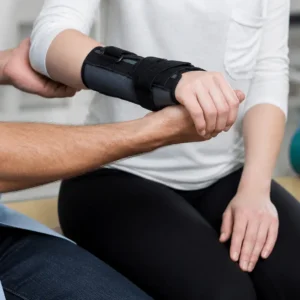 Although it may initially seem as though colliding with a bicycle would present less hazard than colliding with an automobile, this perception is potentially misguided. Given varying degrees of cyclist velocity and accident conditions, injuries suffered by pedestrians can range anywhere from minor to catastrophic.
Examples of typical physical injuries sustained by pedestrians include:
- broken bones/fractures (wrist/arm/hip).
- traumatic brain injury (TBI)/head trauma (even if there was no direct impact).
- neck/spinal cord injuries.
- lacerations/scarring/bruises/road rash.
- soft-tissue injuries (which may be invisible until weeks/months post-incident).
Another crucial issue is that physical symptomology does not always manifest post-collision immediately. Pain induced by adrenaline may obscure immediate symptoms. Head and internal injuries may take several days post-collision to develop fully. For example, this is another reason why seeking immediate medical attention, even if you feel okay, is essential. If you delay treatment for your injuries post-collision, the defendant’s insurance carrier/defense counsel may subsequently attempt to discredit the severity/etiology of your injuries.
Beyond physical issues lies the psychological component. Victims of bicycle-related pedestrian collisions may experience anxiety about walking around traffic areas or having fear-based responses when attempting to cross streets. Symptoms consistent with post-traumatic stress disorder (ptsd) can also arise post-collision. All these concerns constitute legitimate claims for compensation both physically and psychologically; thus, they warrant evaluation by both medical professionals and attorneys.
If you find yourself experiencing anxiety-based thoughts/intrusive memories/alteration in your normal daily routine following a collision, please discuss these topics with your primary physician and/or seek the consultation of a mental health professional.
Immediate actions following an accident with a bicycler
Your choices made immediately following a bicycle collision directly influence your ability to obtain compensation for subsequent losses. Here is what you need to do immediately:
- Find safety first. First and foremost, ensure your own safety. Move to a place off-road/pathway as quickly as possible if you are currently on either. Check in with any individuals involved in the accident only if it is reasonable for you to do so.
- Dial 911. Dial 911 regardless of whether you believe you may have serious injuries. Request police and emergency services respond. Although your injuries may appear minor at the time of incident response, personnel may generate an official document detailing events surrounding the collision, which may be necessary for any future insurance claim/lawsuit.
- Obtain medical treatment. See a doctor/urgent care center immediately. Regardless of how little discomfort you are feeling, it is advisable that you visit an ER/urgent care center as soon as possible after your accident. Do not conceal any symptomatology from your treating physicians.
- Gather information from the bicycler. Gather information from bicyclers who collided with you. Attempt to collect their full name/contact telephone number/address/if applicable, their employer (if they were engaged in delivering goods/services), and confirm if they have liability insurance. Also, ask for identifying characteristics of their bicycle/e-bike (i.e., manufacturer/model/year/etc).
- Speak with witnesses. Locate witnesses to your collision. Take note of any individuals who observed your collision. Write down their names and contact telephone numbers.
- Document everything possible about the incident scene. Document the area where the accident took place. Capture photos/video on your mobile device wherever possible: documenting any injuries sustained by you; documenting any damage caused to their bicycle/e-bike; documenting anything else that occurred during the collision (such as skid marks/potholes/etc), and capturing images/descriptions of signage/crosswalk markings/trailered vehicles/lighting, etc.
- Avoid expressing apologies/Fault at the scene of the accident. Refrain from saying anything that might be interpreted as “Fault” or apologizing for the collision, regardless of how you feel about your role in the collision – no matter how certain you may be that you contributed somewhat to causing the accident – avoid saying anything that could possibly be interpreted as admitting Fault at the scene.
- Inform your insurer of your collision. Notify your own insurance company of your accident. Notifying your health insurance and auto insurance companies of your involvement in an accident is wise, although it is recommended you speak with an attorney before recording statements to any insurer (yours/bicyclers), since what you say can potentially harm your case.
- Engage an experienced personal injury lawyer who has experience handling pedestrian/vehicle accident cases in Portland.
Last updated Tuesday, July 21st, 2026