
 561-338-0420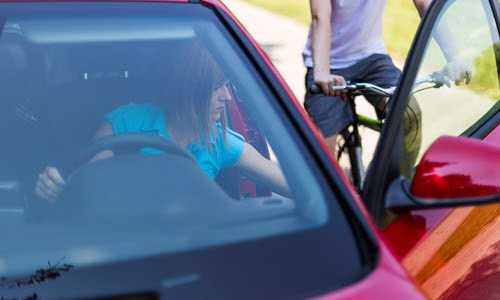
In large biking cities such as Portland, Seattle, and San Francisco, studies indicate that between seven and twenty percent of all bicycle crashes were caused by a dooring. Because parallel parking dominates many of our urban boulevards, this creates a consistent hazard for riders. To illustrate how quickly things can unfold, consider a typical daily commute for a local rider. On her way home from work, she is riding her bike westbound in the bike lane on NW Everett St. At approximately five miles per hour, she cannot possibly stop in time when the rear door of an Uber opens suddenly. She loses control of her bicycle and lands on the ground. She suffers a broken collar bone, bruises two ribs, and is forced to miss three weeks of work due to her injuries. Unfortunately, the damage to her bike was irreparable. Although the driver did not know how serious the collision was at the time, he soon realized that it was more serious than he had thought.
Fortunately, this type of collision is entirely preventable. Both motorists and passengers can help to eliminate this danger by becoming aware of how these types of accidents happen and what each party can do to help mitigate this type of collision. Additionally, whether you are a cyclist, a motorist, or a passenger, knowing your legal options will also provide peace of mind.
Let's Settle For More...

 Click to Call
Dooring Accident Prevention: the Door Zone
The area immediately adjacent to parked automobiles is referred to as the “door zone.” Since most bicycles move at average speeds of approximately ten miles per hour, there is very little time for a bicyclist to react when a motorist opens his/her door. Most modern bike lane designs include a bike lane placed immediately next to parked automobiles. While older designs maximize road usage by placing parked cars immediately next to cyclists, this design pattern creates a natural conflict for cyclists and motorists’ doors. Essentially, a cyclist is expected to ride through a strip of land where car doors can open at any moment. Think about riding down SE Division or NW 23rd Avenue: cars are parked on your right, moving traffic is on your left, and you are stuck in between with no place to go should anything unexpected happen. This is how the door zone operates. Once you understand it, you can begin working towards ways to avoid it.
Causes of Dooring Accidents
While most dooring accidents stem from a motorist/passenger who fails to inspect their surroundings before opening their door, there are many recurring causes for this type of collision.
One reason for dooring accidents is distraction. Motorists finish using their cellphones, find items they misplaced on their seats, become distracted while talking with others in their vehicle, or merely stop paying attention once they park their vehicles. Therefore, instead of consciously opening the door with intent, they tend to open it automatically. Rideshare drop-off zones are especially dangerous since many of these passengers lack driving experience with bicyclists and usually spend most of their time staring at their phones as they exit.
Additionally, high-density parking areas located in busy commercial districts such as Burnside Ave, Broadway Ave., and the Pearl District present a continuous flow of cars arriving and departing. The greater the volume of cars entering/leaving the area, the greater the chance that someone will open their door at an inconvenient time.
Another contributing factor includes conflicting laws regarding Oregon’s requirements for bicyclists. Oregon law generally requires bicyclists to ride as far to the right as practicable, but that rule has important exceptions. You may move left or use more of the lane when reasonably necessary to avoid hazards, including opening car doors, parked vehicles, unsafe pavement, or other dangerous conditions.
Legal Rights Regarding Doorings in Oregon
Under Oregon law (ORS 811.490), drivers and passengers should not open a vehicle door unless it is reasonably safe to do so. Improperly opening or leaving a vehicle door open is a Class D traffic violation. Fine amounts can change, but the citations themselves serve as evidence that drivers/passengers violated the law, and may be beneficial in subsequent civil liability actions involving injured cyclists.
Approximately forty U.S. states have enacted anti-door legislation; however, several states remain without such protective laws, leaving cyclists in those jurisdictions with fewer avenues available to pursue claims against errant motorists.
As mentioned previously, Oregon employs a modified comparative negligence scheme. While it is true that the primary responsibility for causing dooring collisions falls upon drivers/pedestrians, it is equally likely that an insurance company or defendant attorney will attempt to prove that a portion of liability rests upon cyclists, perhaps for insufficiently observing parked vehicles prior to approaching them or for failing to react in sufficient time. If a jury determines that cyclists bear more than fifty percent of liability for an incident, Cyclists will receive zero compensation. Thus, how claims arising from dooring incidents are investigated and presented will significantly influence outcomes.
Furthermore, according to ORS 814.430, cyclists possess the authority to occupy an entire traffic lane whenever necessary to ensure their own safety or avoid potential hazards (including vehicle doors).
Related Article(s)
Hit by a Bicycle While Walking? Your Rights, Next Steps, and How to Recover in Portland, Oregon
Oregon E-Bike Laws: Age Limits, Safety Rules, and Your Legal Rights
Preventing Dooring Collisions Among Motorists/Pedestrians
Motorists and pedestrians have a crucial role to play in preventing dooring collisions. The most powerful behavior that motorists/drivers can develop is called the “Dutch reach.” Developed by the Dutch government and incorporated into its driver’s education curriculum for decades, this method works effectively because of how it alters physical positioning.
Here’s how it works:
- Rather than reaching for the door latch with your closest hand (if you’re driving on the right-hand side of your vehicle), utilize your farthermost hand. If you’re driving, it would be your right-hand; if you’re sitting on the right-hand side of a vehicle being ridden in by another person, it would be your left-hand.
- By utilizing your farthermost hand, you’ll naturally turn your torso and gaze toward the rear of your vehicle.
- Check your side view mirror before attempting to access your door latch; then glance back through your rear windshield as you complete the act of opening it.
- Open your door slowly; then wait briefly before completing the opening motion.
Although seemingly elementary, developing habits is difficult. Once you accomplish this habit, it will become second nature.
Drivers providing ridesharing services might want to post stickers or cards in backseats, reminding passengers to inspect their surroundings prior to exiting the vehicle. Advocates have urged app-based companies like Uber/Lyft to incorporate reminders in their software applications and/or place stickers or signs inside their vehicles indicating that passengers should assess surrounding conditions before exiting their vehicles. This simple measure could save lives.
If feasible, exit from curbside rather than into traffic streams. Although not always possible, this alternative provides added protection.
Let's Settle For More...
Cyclists’ Precautions Against Dooring Collisions
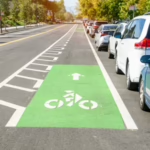 Although state law places responsibility upon motorists/passengers to examine their surroundings prior to opening vehicle doors, cyclists may implement practical measures to minimize their exposure.
- Ride on the left edge of bike lanes (or slightly beyond); maintain at least four feet distance from parked vehicles (whenever possible). Riding in this manner minimizes your likelihood of encountering open vehicle doors.
- Continuously scan parked vehicles for potential occupants. If you notice an automobile has recently arrived or silhouettes visible within front/back seats, slow down & increase spacing.
- Use either a handlebar-mounted mirror or a helmet-mounted mirror, allowing you to observe traffic behind you prior to making any lateral movements. Having knowledge about what exists behind you increases your confidence when making lateral maneuvers.
- Wear helmets. Oregon does not require adult Cyclists to wear helmets; yet attorneys representing clients injured in bicycle accidents continually emphasize helmet-wearing as reducing potential damage & influencing how jurors perceive cases.
- Employ front/rear lights regardless of daylight hours. Enhanced visibility reduces risks.
- Dress brightly. Brighter colors result in increased visibility & reduced risk.
- Exercise extreme caution around stationary ridesharing/delivery vehicles as well as other high-traffic transit modes (e.g., buses/trucks). High-activity zones produce numerous individuals exiting vehicles rapidly throughout short periods & thus pose increased threats
Although dooring is a relatively rare event compared to the total number of miles cycled, dooring accidents can occur on any stretch of road and under various circumstances. Understanding high-risk locations will enable cyclists to anticipate and prepare for potential hazards.
High Risk Locations
The most common areas for dooring incidents are heavily trafficked commercial corridors. Streets such as NW 23rd Avenue, SE Hawthorne Boulevard, and N Mississippi Avenue are among the most commonly cited areas due to the frequent turnover of parking spaces.
Additionally, the proximity to venues such as restaurants, bars, and shopping districts increases the likelihood of dooring incidents occurring during peak evening hours. Nighttime cycling increases the risk associated with dooring as well. Under low-light conditions, drivers are less able to see bicycles, and cyclists are often unable to identify an occupied vehicle prior to a collision. Lights and reflective gear are critical safety features during nighttime cycling.
Data collected regarding cyclist-vehicle interactions reveal that approximately 16% of observed interactions involve an unexpected opening of a vehicle door. Although the act of opening a vehicle door without checking for bicyclists is an easily avoidable action, it occurs enough to cause serious concern. Similar findings have been reported in cities including Boston and San Francisco when reviewing dooring incident trends. Unfortunately, the U.S. currently lacks uniform reporting standards across all states.
Areas within Portland to Watch Out For:
Portland’s dooring incidents tend to be clustered near ridesharing pick-up/drop-off zones near hotels, bars, and Portland’s downtown entertainment district.
Post-Incident Actions
If you experience a dooring incident, the actions taken immediately after the incident can greatly affect your personal safety and the success of your legal claim. Following is a list of steps you should take:
- Move out of the flow of traffic if you are able. Regardless of whether you believe you were injured, your first priority is to move safely out of traffic.
- Call 911. The police report generated from the incident provides documentation of the incident. While Oregon law requires filing reports of incidents resulting in injury or exceeding $2,500 in property damage, it is recommended that you file a report regardless of whether your injuries appear severe.
- Seek medical treatment, even if you think you weren’t hurt. It is common for victims of dooring accidents to initially believe their injuries are minor; however, upon further examination, concussion or soft-tissue injuries may become apparent. A medical record documenting your condition shortly after the incident will provide valuable evidence in support of your claim.
- Obtain the name, license number, and insurance information of the vehicle occupant responsible for the door.
- Take photos of the vehicle door, your bike, your injuries, the roadway surface, any tire marks left behind, and any other relevant factors. Documenting these items prior to removal is crucial.
- Gather names and contact information from any witnesses.
- Preserve any damaged equipment and clothing. Avoid discarding your helmet, jacket, etc., as these items serve as tangible evidence in support of your claim.
- Maintain a record of your symptoms, medical appointments, lost wages, and any changes in your quality of life resulting from your injuries.
Avoid making statements or apologizing for your role in the incident at the scene. Be cautious regarding what you communicate with the driver or occupants of the vehicle responsible for the door. Any statements made at the scene may potentially be used against you in the future.
Insurance and Legal Actions
Once you have completed the necessary post-incident actions, you will begin navigating through a complex process related to insurance and claims.
Oregon uses a fault-based system for determining liability related to vehicular crashes. In order to receive compensation for an injury sustained while cycling through a dooring incident, you must demonstrate that the vehicle occupant(s) responsible for opening the door acted negligently. Oregon’s dooring law (ORS 811.490) can be important evidence in your bicycle injury claim, but it does not automatically decide the case. Liability still depends on the facts, evidence, and any comparative-fault arguments. Insurance companies may try to blame you by asking whether you watched for doors, rode too close to parked cars, or were distracted.
Assuming you have demonstrated some degree of contributory negligence, your damages will be reduced proportionately to the percentage of negligence attributed to you. So long as you remain below 51% negligent, you will still be eligible for damages.
Bicycle Accident Lawyer
Get Your FREE & Confidential Case Review Today.Damages Recovered in Dooring Cases
Typical damages recovered in dooring-related lawsuits include:
- Past/future medical expenses,
- Lost earnings/income,
- Pain and suffering,
Depending on the severity of your injuries, these damages can amount to considerable sums.
Dealing with an Insurance Adjuster
Adjusters working on behalf of insurance companies are primarily focused on settling claims at minimal expense. One way they accomplish this goal is by requesting that you provide them with a recorded statement prior to knowing fully the extent of your injuries. Prior to providing any type of response to the insurance carrier representing the vehicle occupant(s) responsible for opening the door, consult with an attorney specializing in bicycle accidents.
Attorneys knowledgeable in bicycle accidents will assist you in gathering and preserving evidence, establishing the true value of your claim, negotiating directly with insurance carriers on your behalf, and advocating on your behalf when the adjuster attempts to downplay the nature/extent of your injuries.
A bicycle accident attorney familiar with dooring accidents can make a meaningful difference in recovering fair compensation.
Consequences Resulting From Dooring Incidents
Cyclist injuries sustained while experiencing a dooring incident range from mild (road rash) to catastrophic (spinal cord injuries). Serious dooring incidents often result in traumatic brain injuries (concussions), broken bones, road rash, and/or shoulder/wrist injuries caused by attempting to brace oneself prior to colliding with an object.
Recovery Time Required After a Dooring Incident
Most physical recoveries from serious cycling-related injuries require several weeks/months. Additional complications arise when factoring surgeries, physical therapy sessions, additional diagnostic testing/imaging, specialist visits, missed workdays, etc., into consideration.
Medical Providers Also Emphasize Long-Term Psychological Effects of Dooring Incidents
Returning to cycling following a serious dooring incident can prove challenging for individuals. Many cyclists experience fear/anxiety relative to riding alongside parked vehicles, or simply cease commuting via bicycle altogether. Such a loss represents not only an interruption in a primary mode of transportation but also a loss of opportunity for regular exercise and recreation activities that previously provided great enjoyment.
Financial Consequences Sustained Due to Dooring Incidents
It becomes increasingly expensive to address issues arising from medical expenses incurred while treating a dooring injury; lost wages; potential ongoing healthcare requirements; and/or property damage (a bicycle can cost upwards of $1,000-$2,000).
Establishing Liability Through Strong Claims
Understanding all of the above losses is key to ensuring that a successful lawsuit addresses each one accordingly.
Creating Safe Streets Through Design & Advocacy
Behavioral modification among cyclists is critical. Nevertheless, so too is street design. Buffered bike lanes that separate bicycle travel paths from parked vehicles through painted buffers can dramatically decrease dooring risks. Similarly, protected cycle tracks that utilize curbs/barriers separating bicycles from motorized traffic eliminate virtually all dooring risks. Over the last few years, Portland has expanded its buffered/bike-only bike lanes along major commercial corridors and continues to advocate for increased implementation.
Local awareness campaigns emphasizing the prevention of dooring incidents have begun popping up in Portland. Michael Colbach’s video focusing on preventing dooring incidents serves as a prime example. Educational campaigns focusing on reminding vehicle occupants to “check before opening”, combined with signs placed inside rideshare vehicles, offer an effective means by which large-scale behavioral modification can occur.
If You Want Safer Streets – Here Are Ways to Help Make Them Happen:
- Attend local Portland Bureau of Transportation meetings scheduled during times when planning new bike infrastructure initiatives is underway.
- Contact your City Commissioner’s Office.
- Support local organizations advocating for pedestrian/bicycle/transit development in Oregon (e.g., The Street Trust).
- Share information with your friends/neighbours regarding safe street usage practices.
Last updated Monday, July 20th, 2026